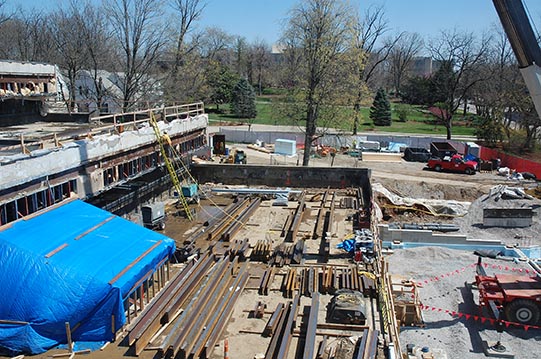
Working toward LEED Gold certification
We contacted
the architects for the SPEA addition and they, along with the University
Director of Sustainability William M. Brown, provided
this information on how the SPEA expansion and renovation is working to meet
LEED (Leadership in Energy and Environmental
Design) certification.
Here
are the talking points they have provided regarding the sustainable design
goals of our building project:
- The
site is being developed to maximize open space and control the quantity of storm water
runoff.
- Reflective
surfaces on the site and roof will mitigate the urban heat island effect.
- No
potable water will be used for irrigation and water-saving fixtures will reduce
water use in the building by 35% compared to industry average.
- Energy
use will be 18% below average for a building of this type.
- Enhanced
commissioning will assure that the building is constructed to function as it
was designed.
- Renewable energy credits will be purchased to offset 100% of the
building’s energy use for at least the first two years of operation.
- More
than 75% of construction and demolition waste will be diverted from the
landfill.
- At
least 20% of the materials used in the building will be recycled content and
extracted, processed and manufactured within the region.
- Most
of the wood used in the project will be FSC certified.
- Outdoor
air delivery will be monitored. There is an indoor air quality management plan
in place during construction.
- Low-emitting
materials, including adhesives and sealants, paints and coatings, carpet, and
composite wood products have been specified.
- Thermal
comfort has been designed into the project and more than 75% of the spaces will
be day lit.
- Maintenance
will adhere to a green housekeeping policy to assure continuing indoor air
quality after occupation.
- The roof
structure is over-sized in order to accommodate a potential future installation
of solar panels.
- The
SPEA site is urban infill, not a greenfield site. It has the density and
community connectivity and existing infrastructure in place to make for
walkable access.
- Public
transportation access is excellent, reducing the need for single occupancy
vehicles.
- Preferred
parking will be provided for low-emitting and fuel-efficient vehicles. No
parking spaces will be added, encouraging occupants to seek alternative and
more active forms of transportation.
 |
| These trees, on the SPEA Plaza, have been carefully boxed to be transplanted at another location. |